Sunday, January 1, 2012

December 2011

Christmas in my village is about family. December is the time people come home who otherwise stay elsewhere for work. My shopping town, Thohoyandou, is extra crowded with the influx of people to the surrounding areas. The school year ended in early December and school is closed until mid January when a new school year begins. This is my first Christmas & New Years away from home - only one more to go.

Did not want to be alone and decided to go to a Coffee Bay on the Indian Ocean where a couple of other PCVs from our group were going. During in-service training, at the beginning of December, I did not book my bus and when I went to town the Monday before leaving I found all buses from Pretoria were fully booked until Christmas Day. It was an overnight bus that brought me to Umthatha (aka Mthatha) and then I kept asking about transport until I finally figured out how to get to Coffee Bay. My friends came from Northern Cape with a rented a car and it took them 1 1/2 hours to get to the Coffee Shack Backpackers in Coffee Bay so it was not too bad my getting there about 4 hours after arriving in Umthatha considering we had to wait for a taxi to fill up before it would head out.


Needless to say I did not sleep well on the bus and was pretty tired upon arrival. Very disapointed the internet access could only be accomplished on their computers for 10 Rand per 15 minutes - no Skyping family & friends. And my first night at Coffee Shack there was very loud music until the wee hours of the morning. Almost left, but decided to give it one more night and I am very glad I did. Many of the young people left and a more mellow crowd moved in. I met some very nice PCVs from another group and also met a man who works for the UN who does IT development. Who would have thought that on vacation I would have made such a valuable contact. There are also many very nice things about the place. The white sand beach is amazing.


Coffee Bay BeachFlying Kites at Coffee Bay Beach

Hiking trails. Free coffee. Beautiful weaver birds that hang upside down on their nests and weave pieces of thatch and dried grass into them. The nests are enclosed with small openings for the bird to enter. They construct their nests high in the trees starting with a small ring they attach to a branch.


Weaver birdsMore weaver birds
This local man is a drummer and drum maker. He also gives classes in drum making. He is repairing the top of a drum using a new piece of goat skin.


Replacing drum top using goat skin, string, wood and hoops
My respect for Coffee Shack Backpackers grew as I learn more about the place.  Coffee Shack is environmentally friendly and conscientious. They plant only indigenous plants, recycle and do many things to help the villagers of this remote community. Belinda, who runs Coffee Shack, says they are open all year and visiting is an even better experience in the winter because it does not rain, the warm Indian Ocean moderates the temperature so it is usually between 15 and 20 centigrade day and night and the area is less crowded than during summer break. 

Sunday, December 25, 2011

Summer

It is summer and the rains have begun. When it rains and is overcast the weather is nice in my opinion. The days when there is no rain and it is not overcast can be miserable. The temperature is between 30+ and 40+ degrees Celsius (90 to over 100 F) and it is humid.

The morning is definitely the nicest part of the day. People in the village rise very early. They get up and immediately begin working in their gardens and yards because as the day progresses it becomes increasingly difficult to do anything besides sit and sweat profusely. The water in my room becomes warm enough to make coffee or tea, which I definitely do not want to do. And my fan pushes hot air around but without it the air is stifling.  Although many people still wear long sleeves and sweaters when I am sweating.  Below is a picture of an older woman hoeing, notice she has a cap and sweater on.  I have never seen her without both of them on.  And it is not only older people.  In the schools many
learners come to school with sweaters, jackets and, if overcast and pleasant to me, learners are likely to be wearing jackets and hats because they are cold. 

There is a big tree along the path from the school and water tap to home. It is a popular place and one I frequently stop at as the temperature under the tree is noticeably cooler. But anywhere there is shade is a welcome relief and where people sit during the day.


Some people still work during the hottest parts of the day. I was sitting in my room in front of the fan working on my computer when I noticed a constant noise outside. I went out and saw a man who was hired by my family to hoe the weeds from the yard so maize and peanuts could be planted. I asked him why he was working at this time of day and he said he needed to work so he could eat.


In my village corn is planted everywhere possible. Peoples whole yards are planted. 

Families and people of all ages work together to hoe, and continually hoe after planting to keep the weeds down so the corn can grow.


There are also a lot of mango trees with mangoes although some trees have less than the usual amount of mangoes because they were damaged by the big storm.

Because it rains and is humid there are now a lot of bugs. Here is a picture of Daphney scooping up the bugs she has swept into a pile from the cement around her house.


A couple of mornings this week I have noticed the air full of birds flying back and forth and all around. I am assuming that they are catching the bugs for breakfast.


Sunday, November 13, 2011

The Big Storm

Last month I was shopping in Thohoyandou when it began raining really hard.  I didn't bring an umbrella and ran to the bus area, found my bus and got on.  I was soaked and there were no seats.  I was standing in the middle of the bus when 3 young boys called to me.  They were sitting in 3 seats and squashed together so I could sit with them.  They called me by name so I figured out they were from Lukalo.  It was so very nice of them to make room for me and I am sure it was not all that comfortable for them.  I really appreciated their kindness as I did not want to have to stand for 54 KM after walking around town all day.  And the trip home can take a long time because of the number of stops the buses around here have to make.  The other morning it took 1 3/4 hours to get to Thohoyandou by bus.

As we got closer to the village we could see roofs blown off of houses and when we reached the village their was a great deal of mud that had come down the slope across the road.  in the dusk I could see the sign for the primary school was blown over and a huge branch had fallen from a big tree near the bus stop.  As I walked towards my house I could hear hammering.  People were trying to fix their homes and protect their interiors from the rain.  My room was fine but the main house had great deal of water in it as did the house of the grandmother of my host family's children and many other homes in the area.  There were at least 10 houses which had the roofs blown off and one, in which people were gathered to drink the local home brew, had a tree limb fall on it.  Some of those people were hurt but all survived.
The roof blew off the Lukalo Primary School kitchen A roof lying in a field far from any house

Many large tree limbs had fallen down and men hatcheted away at them for days following the storm.  Few, if any, chainsaws here.


I was told that a tornado came through town and that it had hailed.  They had to struggle to figure out how to tell me in English about the hail.  I asked if anyone saw a tornado and no one said they did but they said they heard a loud noise and made a sound like I would expect from one.  Tornadoes are very uncommon in this area as I discovered from watching the news that night.  I had to ask the children to turn the news back on as they switched channels to see some soap opera or something or other.  Soap operas are very popular here in South Africa and many people of all ages watch them.  Some of the soap operas have characters that speak in different languages which is one educationally redeeming quality of this past-time.

Lukalo, Venda and Shangaan-Tsonga

Lukalo is a very nice village.  I am blessed because the village tap at the top of the hill gets it's water from a pipe by the tar road that comes from a dam.  We have a plentiful supply unlike some rural areas of South Africa.  We have only had one day that we had to go without water because they were fixing the pipe.

Fetching water at the tap
Many of the houses here are built in a traditional round shape.  They are made of homemade brick covered with cement. There are multiple buildings like this with each one serving a special purpose - a kitchen, bedroom, sitting room. Although the more square western type of homes with multiple rooms under one roof are now being built. Thatch was used on the roofs of these round buildings and I have been told that the houses with thatched roofs are much cooler in the summer and warmer in the winter. But these roofs have to be replaced or new thatch has to be added which makes upkeep an constant task. Also things can live in these roofs. One PCV lives in a large round house and said things would fall from the roof onto his belongings. His father suggested he put cardboard in the rafters which has helped.

Round houses - separate rooms
Lukalo has a beautiful hill with patches of green stone.

Lukalo Hill
There are mango trees everywhere.  According to a random fact found at http://www.golimpopo.com/events_details.php?event_id=120 "Limpopo has the largest areas inhabited by rural communities who are still living as they used to for centuries".  The following picture was taken under the bridge separating Venda from the Shangaan-Tsonga area of Limpopo.
Washing clothes and hanging them out to dry
The Venda and Shangaan-Tsonga people are very nice.  I saw these women and asked if I could take a picture of them in their traditional clothes.  They said yes and began doing their traditional dance for me.  First one woman, then another joined her and then more joined them.  Notice how white their shoes are.  Amazing as mine are always covered in dust.  They are holding up a cloth that goes over their clothes so I can see their skirts.  They are very proud of their clothes and their dancing.
Shangaan-Tsonga dancers in traditional clothes
According to http://en.wikipedia.org/wiki/Tsonga_people the Tsonga people have gained attention for their low-tech, lo-fi dance music called Tsonga electro which has been pioneered by South African producer "Dog".

Barack Obama Nelukalo

One day I had to go to the bathroom while at school and there was no toilet paper.   Thankfully I was at the school that is just up the hill from my home so I went there. 

On my way back to school, I saw a woman coming from behind some trees next to a path leading to the river.  She was carrying a toddler (between 1 and 2 years old) on her back and a stack of long pieces of wood on her head.  It looked like she could not have gotten another piece of wood on the pile on her head without dropping it all.


As I watched amazed and wondering how she got the wood on her head and the baby on her back without any help, she came towards me and I recognized her and her child from the neighborhood.


She said her child was saying "Joni, Joni".  The child is one that spends a lot of time with the older children on the road and he must have learned my name from them as each one of them says "Hello Joni.  How are you Joni?" multiple times as I go by and as they follow me up and down the road leading to my house.  The mother had not seen me at first and was wondering why her baby was saying "Joni" then she laughed and kept telling me about her child saying "Joni, Joni, Joni".


It reminded me of something that happened when Rachel was between 1 and 2 years old.


We had moved from an all white neighborhood/town/area to Toledo and were employed as teaching-parents in a group home for chemically dependent adolescent girls.  We had hired a black woman to work at the home whose name was Kim.  One day I was in a Toledo grocery store with Rachel when she started yelling "Kim, Kim" and was reaching out her hand.  I realized that she was calling to a nearby black woman who was not Kim.  Since Kim was the first and only black person Rachel had met up until that time, I surmised that she must have thought all black people, or black women, were named Kim.


I have been told that I am the first white person many of the children here in the village have seen and they are amazed.  I was thinking about this and wondering if this child will be in the shopping town and see another white woman, very unusual here.  And if this happens, will the child call to her with my name as Rachel had done?  And will her mother realize why and laugh?


This week I found out this child's name is Barack Obama Nelukalo, named after our president of course.  Nelukalo is the sir name of the village's headman and thus the royal family of the village.  Although royalty, they have the same living conditions as everyone else in the village.

Lukalo and Mushiru Primary Schools

My job here is to help teachers with teaching, subject matter and technology and to help the teachers and community to implement sustainable programs they can carry on after I leave.


Lukalo Primary School Mushiru Primary School
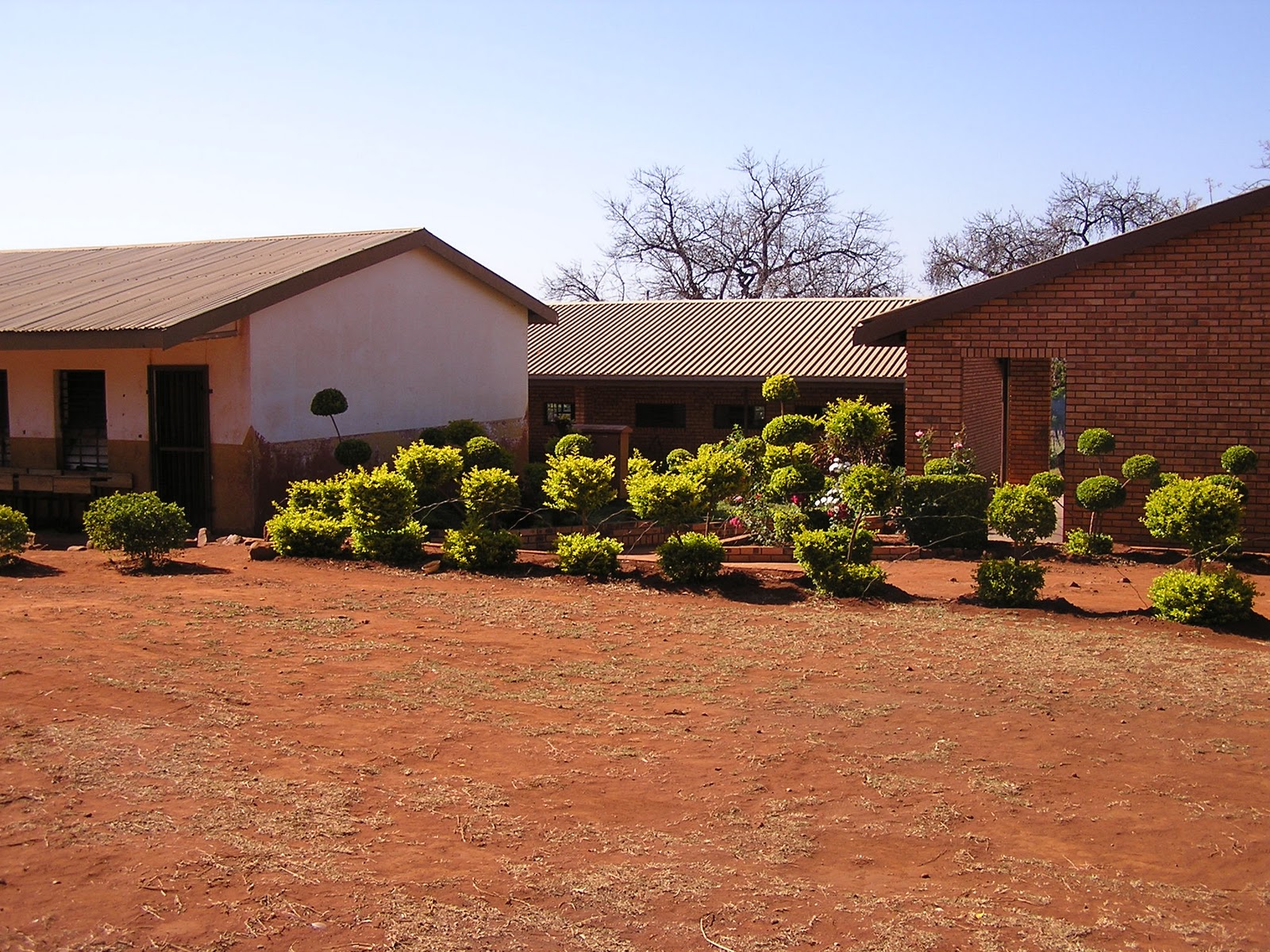
I have been assigned to two rural primary schools in the villages of Lukalo and nearby Murshiru. The school attendees are called “learners” as the term “students” is reserved for those attending institutes of higher education. Lukalo Primary School is up the hill by the water tap and Mushiru Primary School is about 2 KM down the road. They are both primary schools with grades R - 7. The rooms empty to the outside so the schools are what we would term campuses. The kids may have a book for a class but usually the books are kept in the classroom and they have to share.   New curriculum is being implemented in some grades and new books have been ordered.  I have suggested that several old books be put in a library and the rest given to learners so they can have a book at home.

Usually everything is written on the chalkboard and they have to copy it. I spent 2 days this past week trying to clean the chalkboards at one of my schools because they were so full of chalk that it was hard to see the writing for me so I thought it must also be for the kids. Needless to say the boards are getting full of chalk again. Their chalkboard erasers leave much to be desired. They are pieces of wood with a thin piece of foam or felt on the bottom. I shredded 2 washcloths trying to get the grime build up off the chalkboards and found out after school that one of the cloths I shredded one of the learner’s brought to school from home to wash the classroom floors.  The girls wash the classroom floors once a week and sweep the other days.


This week I saw a boy with a stub of a pencil and no eraser trying to sharpen the pencil so he could write. Sometimes they share pens and pencils and the rulers they use to create lines in their notebooks to separate one day’s work from another or for content purposes. I have seen children come to the classroom of a sibling or friend to borrow a ruler.


All the schools in our district have received 2 small Acer laptop computers, 2 projectors and 2 tripod screens recently. The laptop is preloaded with a program called “HeyMath!” to be used for math education purposes in all grades. It also has Microsoft Office Suite preloaded but the product key for this software has not been entered and without the product key the programs can only be used a maximum of 22 times. No USB drives are allowed to be put in these laptops per the Circuit Manager because computer viruses are rampant here and they want to protect the “HeyMath!” program which costs some sum of money - don't know how much. The laptops have big hard drives with lots of extra space for learning software but it can’t be installed because of the no USB policy and the fact that the laptops do not have a floppy, CD or DVD drive – they only have a USB interface. The result is that the laptops can only be used for Math classes. I have been working with some of the teachers to use this resource in class but usually it sits in the storeroom unused and underutilized. One of my goals while here is to help the teachers learn to use the available technological resources.


The schools I am in are small. The number of teachers allocated to a school depends on the number of students enrolled. There are eight grades (R – 7) but each school has only been allocated 7 teachers, including the principal and heads of department, due to enrollment. So the principal and department heads teach all day and someone either teaches two grades together or one class does not have a teacher. Teaching two classes at once is difficult because the curriculum is different for the classes so sometimes a teacher moves between two classrooms giving one an assignment while teaching the other. But this requires a very dedicated, organized and motivated teacher. Many times there is more than one class without a teacher as principals and teachers go to meetings, higher education classes, workshops or are absent for other reasons. This week several teachers met with other teachers in the district to write circuit-wide exams while, at the same time, other teachers were at workshops for the new curriculum. There are no substitute teachers for occasions such as this. One good thing I have seen is learner-lead study/learning sessions when a teacher is not present in the classroom.

Sunday, October 23, 2011

Food

Going shopping is quite hard without a car especially because I live so far, 54 kilometers, from my shopping town of Thohoyandou. 

The stores have excellent juice including many 100% mixed juice blends.  Many juices and brands of milk come in waxed cardboard containers and need no refrigeration until opened.  The milk is called long-life milk and comes in full cream and reduced fat.  The coffee that I have had here is instant.  I have also seen coffee and chicory blends, but it is hard to find coffee in the store and I have not seen a coffee maker for sale anywhere I have been, although I am sure they have them somewhere.  Some people have told me they bought French presses but I have not seen one of those either.  Jessica had given me some Starbucks Via instant coffee I brought with me and I made my first cup of relatively real coffee in a long time.  It was very strong.  It seems no matter how much of the South African instant coffee you put in your cup it never gets strong.  I read on the Peace Corps wiki that there is a company that will send Peace Corps volunteers free coffee. 

Some grocery stores do not carry cheese and when you do find cheese it is processed cheese, cheddar, gouda or feta.  I have found other cheeses in one store in Pretoria but they are very expensive.  Cheddar and gouda are quite expensive here in our shopping town (R69.99-72.99/Kg) compared to in Pretoria (R49.99-59.99/Kg on sale).  Big bags of ruffled potato chips are nonexistent as far as I know, even in Pretoria.  They have lots of little bags and most are flavored, but I have only seen larger bags of cheese puffs.  I guess that is their preferred method of cheese intake.

I do not think they have gotten the health food awareness education that we have in the states.  Brown bread actually costs less than white and I have yet to find a peanut butter without hydrogenated oil.  Also all the yogurt I have found contains sweeteners.  Sugary sweets are quite popular as a treat. 

It seems that pap, bread, yogurt and chicken are the rural SA staple foods.  They also eat a lot of cabbage, butternut squash, beetroot, beans and eggs.  Pap is made from corn ground very fine and cooked in water.  There is a special tool used to stir pap so there are no lumps.  When prepared It is very stiff and sticks together.  You can pick it up in one piece if separated into individual servings when first made and you are careful.  Another name for pap is porridge.  It is made thinner and eaten with sugar for cereal, but thick is the preferred method of preparation.  A lot of people eat it for 2-3 meals a day along with a gravy and meat and/or one or more of the foods I mentioned above.  Dried whole kernel corn is called samp and is usually cooked with beans. 
 

In school every week every lunch includes huge portions of pap, which is quit bland like bread or potatoes.  One Monday there was pap with roasted termites – a delicacy.  
Tomato gravy, roasted termites and pap
I was told you have to watch how you eat them and they are the kind of food that is used on the Fear Factor TV show. I did not try them.  I had wondered why there were huge termites mounds everywhere and no one did anything about them.  

On the other days of that week they had chicken feet and gravy, chicken necks and gravy, cooked squash leaves with scrambled eggs and fish cooked in tomatoes along with their pap.  These were special meals cooked for the teachers.  The students ate samp and beans which is really quite good and nutritious.  There were also oranges all week long.  They must be ripe this time of the season.  I hear mangos will be ripe in the summer about December.

I was in town one Saturday shopping and there were many street vendors.  They sold a lot of things especially fruits and vegetables.  Women were doing bead work; men had set up huge speakers and were singing to music.  Street vendors were selling dried worms which they claim taste better than crabmeat and are very nutritious.  A lot of people I meet ask if I have eaten the Venda worms yet.  They look like caterpillars to me and I plan to put off eating them as long as possible.  I have been told you have to watch how you eat them also but not as much as the termites. 

I first heard about these worms in Makapanstad when I told them I was going to Limpopo.  They told me that there were many fruits and worms there that are very delicious.  In Limpopo I was shown a tree in the school yard that the worms come onto and was told it will have lots of worms.  So maybe I can get some great pictures of them while they are alive.  I think they are very colorful.


People have shown me some of the things they learned to eat to survive when there was no food.  They have really learned what they can and cannot eat from their environment like the experts on the shows that teach you how to survive.  It is hard for me to imagine what these people have gone through in the past.